
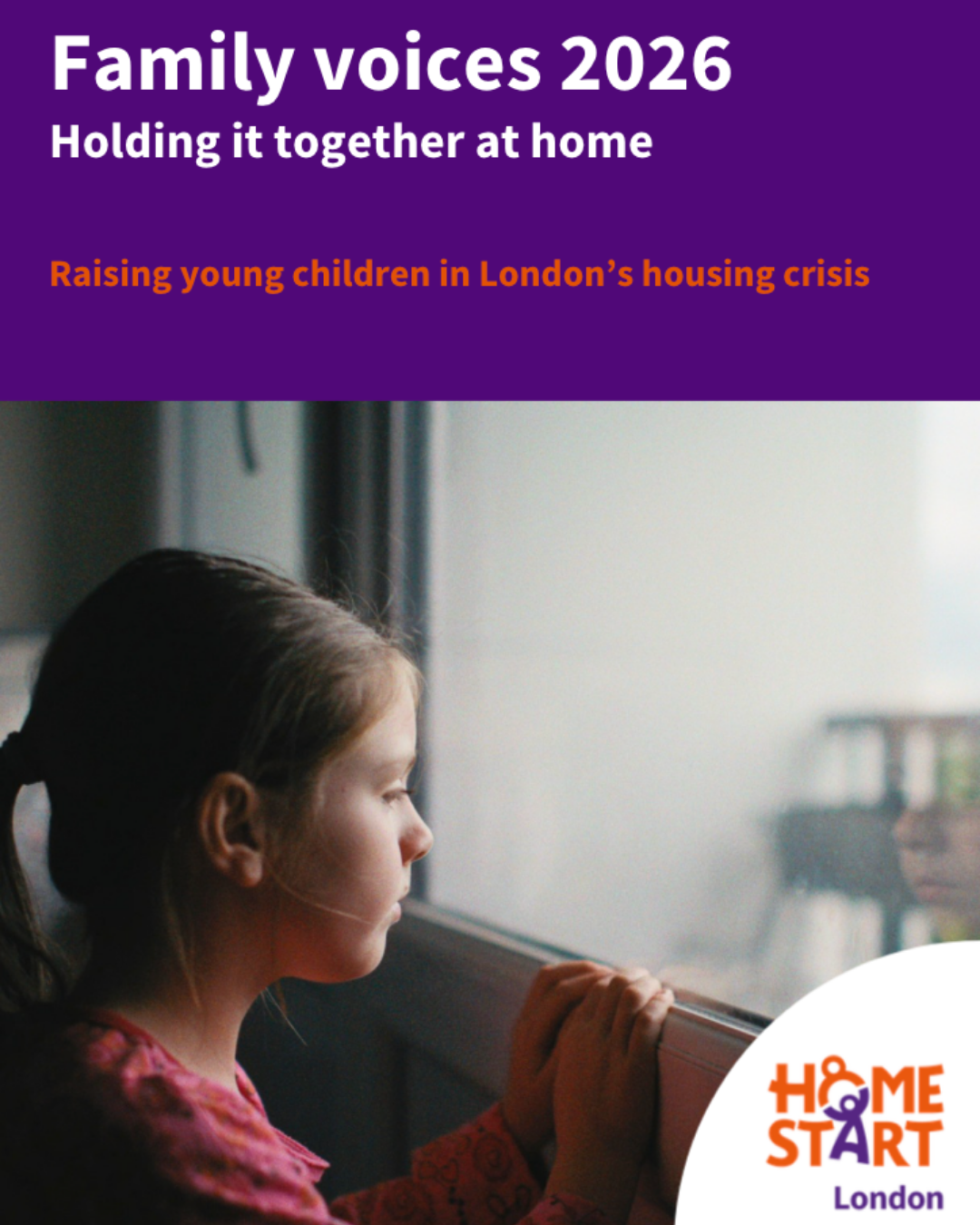
London’s housing crisis is a childhood crisis: new research reveals the impact on families with young children
New research shows a quarter of families supported by Home-Start do not have enough space at home for their children to safely move and play.
Every child deserves a safe and stable home: somewhere they can play, learn and thrive.
Yet for many families supported by Home-Start in London, this is far from the reality. Housing problems are limiting children’s opportunities to play, grow and develop, while leaving parents worried about the impact on their wellbeing.
Our new research, co-designed with Home-Start families, reveals the experiences of 350 families with children under five living through the capital’s housing crisis. More than half, (58%), say their housing situation is having a negative impact on them or their family
For families experiencing housing problems, the impacts on their children are a major worry. Nearly two thirds of families (65%) are concerned about how their housing situation is affecting their children, particularly their safety (34%), health (30%), and learning and development (23%). Their stories show how unsafe and unsuitable housing can undermine every aspect of family life.
The research also highlights the difference that trusted support can make for families navigating incredibly difficult circumstances. 88% of families receiving Home-Start home-visits or attending local groups reported improved mental health and wellbeing, while 84% said they felt better able to support their child’s learning and development.
“I felt seen and cared for during the most difficult times of my life. Their support meant a lot to me. I was in a very dark place and they made me see a ray of light.”
– Parent survey respondent, North London
No safe space to play and grow
The first 1,000 days of life lay the foundations for a child’s health, learning and wellbeing. Children need space to crawl, play, explore and grow. Yet a quarter (25%) of families that we spoke to say their child does not have space to play and move around safely. Among families living in temporary or emergency accommodation, this rises to 32%. For some families, ‘home’ has been reduced to a single room where everything happens: sleeping, eating, playing and caring.
“We just play in the front room. We’re just in the front room. So we sleep in the front room. We do everything in the front room because this is where the mould is less… So it’s both me and her, and we’re here on sofa beds.”
– Parent in private rented accommodation, East London
Families shared how a lack of space affected their children’s ability to reach key developmental milestones, such as learning to crawl, walk, or toilet train. Some described holding their child back from moving more, because it was not safe.
“My son is a very active boy. He’s been trying to walk since he was 8 or 9 months old. But that was a huge challenge. Where is he walking in our flat? Nowhere. There’s no space for him to walk, so he would try to get on top of tables, chairs, and climb the Kallax unit. I had to constantly grab him and put him back in his rocking chair, crying. It was so challenging.”
– Parent in council housing, Central London
‘Home’ as a source of stress for the whole family
More than 180,000 Londoners, including one in every 21 children, are currently living in temporary accommodation (London Councils, 2025), while housing costs continue to drive poverty (Trust for London, 2026). Nearly three in ten Home-Start families (29%) are living in overcrowded homes, while one in five (20%) are dealing with damp, mould or pests. These conditions are even more common for families living in social housing.
“Because he’s a child, he likes to go and open cupboards, and I’m like, “no, no, no, don’t touch that”. And to the point where he’s now started saying, “Mummy, can I go in here, or are the bugs in here?” So he’s aware.”
– Parent in housing association property, West London
Parents told us about spending hours chasing repairs, cleaning mould, navigating housing systems and preparing to move again after only a few months. It’s widely accepted that moving house is one of the most stressful life events we can go through. For the families facing being forced to move every few months, there’s no respite from that stress.
“We are always being moved from temporary accommodation. In two years, we’ve had to move six times. Every time I get an email from the housing officer, I feel so anxious. I’m a single parent with two kids and have no support. Every time we move, we don’t know the area, we need to find new schools and new friends – it has a big impact on my children.”
– Parent in temporary accommodation, Central London
The hidden cost of the housing crisis
London’s housing crisis doesn’t just deprive families of a safe, affordable place to live. It also consumes their time, energy and emotional capacity. 61% of our families experiencing housing problems say this is affecting their mental health, and 43% say they are making parenting harder.
A parent living in temporary accommodation told us:
“Living in a hotel is affecting my mental health and causing severe anxiety. It has also made it much harder to care for my three children. Additionally, the stress has caused me to experience terrible headaches and has negatively impacted my overall health.”
– Parent in temporary accommodation, Central London
Another parent reflected on how the stress and uncertainty of housing problems had undermined her confidence as a mother:
“A lot of the time, it makes me feel not good enough as a mother, that my daughter should deserve so much better because I should do better. Yes, it makes me feel very low. It sends me like into a spiral, and I’m really struggling. It sends me into a big spiral, and I’m struggling like get out, do anything, do things as simple as getting up.”
– Parent in private rented accommodation, North London
Families are making impossible choices to get by
For many families supported by Home-Start, these challenges are compounded by severe financial hardship. Almost a third (32%) of our families meet the technical definition of destitution, defined as being unable to meet basic physical needs, such as staying warm, dry, clean and fed, over the previous month. Whilst ‘destitute’ may seem a stark and emotional term, families involved in the research felt it was important to reflect the severity of hardship that many are managing.
“It’s important to use this language and not to soften it up for people. As parents we use language all the time to make things seem less bad and to mask the reality but if we want to make an impact we have to say what it is we are really experiencing. It makes people feel uncomfortable but there needs to be more awareness of the realities of families’ lives.”
– Family Champion
Our families told us about skipping meals, rationing nappies and formula, turning off lighting or heating despite needing it, and relying on food and baby banks simply to get through the month.
“We have started using baby banks for clothes because his clothes are too small for him for the summer. I used my first food bank last week. I used another bank for toiletries the week before. So you know, I can just about cover our bills.”
– Parent in housing association property, Central London
We heard from parents working hard to keep their families afloat, often through personal sacrifice and incredible determination and resourcefulness. Reiterating last year’s research, parents described the constant calculations and emotional strain of parenting with financial stress:
“Sometimes we might go without, and we can do certain things, or have to go a bit lower. It could be certain foods. Could be as simple as not sending her to nursery because I can’t do a packed lunch, just topping up their electric meter, or even paying the council tax.”
– Parent in private rented accommodation, North London
“You’re worried about how you’re feeding them, and you’re worried about what they’re going to ask for when you go out, or if you forget something, how you’ll pay for that thing that you forgot, and all of those things.”
– Parent in housing association property, Central London
These aren’t simply housing problems. They are childhood problems.
For too many families with babies and young children across London, home is not a place of safety and opportunity. It is a source of stress, instability and poor health. Families told us they often feel alone and ashamed when trying to get help with their housing.
“Every time I speak to the council… I feel like they’re already trying to back themselves up and defend themselves. I’m just another number. That’s what I feel like. I feel like there’s no sympathy or empathy in it anymore. Everything is just about legal requirements.”
– Parent in council housing, Central London
Having someone to stand alongside you
The study shows how Home-Start helps our families through some of the most challenging periods of their lives. We take the time to build a relationship with parents so that they feel able to speak honestly about what they’re going through, without fear of judgement. Our families told us that knowing that someone will be there to speak each week means they don’t have to navigate difficult situations and complex housing systems alone.
“Home-Start helped me through the journey of managing my kids, my home and emotionally helped me to manage and be present for my kids.” Parent survey respondent, South London
The impact is significant. Among families receiving Home-Start support for three months or more:
- 88% report improved mental health and wellbeing.
- 85% feel more confident as parents.
- 84% feel better able to support their child’s learning and development.
- 90% have accessed additional support through Home-Start, with 71% saying they would not have known about this support without us.
Families also report that their children have more opportunities to play (68%), try new activities and experiences (53%), play with other children (36%) and improve their speech and communication (23%).
“They helped us to get out more as I was unable to do this task alone with three children under 4. This made a huge difference to my own mental wellbeing and gave the children the opportunities to partake in activities they otherwise couldn’t have.”
– Parent survey respondent, West London
“They really helped me gain my confidence back and able to leave my house and travel on public transport. Helped me understand my child’s needs and give an ear to talk to without judgment.”
– Parent survey respondent, West London
A way forward
London’s housing crisis is a childhood crisis. But it doesn’t have to be.
Alongside calling for urgent action to improve housing supply, affordability and standards, we are using this research to encourage policymakers in London to recognise the vital role that trusted, relationship-based support plays in helping families navigate the pressures of London’s housing crisis.
When we asked families what support they most need in the months ahead, emotional support to manage difficult circumstances came top (41%), followed by help with food and other essentials (36%) and housing support (34%).
The message is clear: emotional support isn’t a luxury, it’s essential. When parents are overwhelmed by poor housing, financial pressure and uncertainty, having someone they trust alongside them can help them cope, regain confidence and give their children the best possible start in life. Childhood begins at home. Until every family has a safe place to live, families should not have to face these challenges alone.
Read the full report here to explore the research and hear directly from families about their experiences.
Family Voices 2026 Holding it together at home. Home-Start London Report